Neurofeedback Guide. What it is and how it works
September 5, 2024 | 4 min read


Mental performance
September 5, 2024 | 4 min read
Mental performance means the speed and efficiency with which a person can process information, solve problems, make correct and wise decisions, and accomplish cognitive tasks.
Of course, performance is influenced by factors such as the environment in which we live, daily habits over recent years, rest levels, stress, and life experiences.
Achieving mental performance is an initiatory journey, with intermediate steps of satisfaction as various brain functions harmonize step by step.
One of the critical factors today that massively influences individual and group performance is daily habits. For optimal functioning, the brain needs a variety of activities, sometimes opposing ones, that necessarily support each other: maintaining focused attention on a subject, for example, requires small periods of “staring at the ceiling” or defocusing to complete a full brain cycle. Thus, during moments of active attention, certain neural areas, usually cortical (located on the brain’s surface in well-defined areas), operate ideally at specific optimal frequencies, while moments of “staring into space” activate an entirely different set of brain areas, usually subcortical (located deeper within the brain), corresponding to entirely different specific functioning frequencies. This second set of subcortical areas actively supports (when synchronized and coherent) the first set of areas (the active ones), producing long-term performance.
What happens when, in daily habits, we fail to activate these two sets of areas alternately ? The internal synchronization deteriorates, connectivity and operational efficiency decrease by up to 40%, the person becomes tired, inattentive, unable to make quick and healthy decisions, gradually depleting brain reserves, and in everyday life, the quality of personal life and work drops to unacceptably low levels.
In the first interview, before initiating a Neuralyst approach, we review the client’s current situation using a questionnaire, giving us an initial idea of how the brain currently functions.
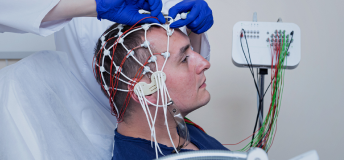
Then, with the help of a full-brain qEEG scan, performed according to our protocols, we evaluate the frequency, synchrony, connectivity, and coherence of all brain areas, both static (with eyes closed and open) and dynamic (during the scan, the client performs a selection of small tasks to highlight the communication between the scanned brain areas).
The result is a complex report, which we then discuss with the client in a revealing one-hour session.
Based on the resulted report, we then calculate the intervention strategy for neural training sessions, personalized according to the client’s desired objectives. In each session, the brain learns new synaptic pathways and performance activation patterns that allow a healthy and optimized flow of neural activity in terms of activation level, synchronization, coherence, and connectivity.
Mental performance rests on several key aspects, which we will also analyze from a “technical” perspective:
Neurofeedback Guide. What it is and how it works
September 5, 2024 | 4 min read
September 5, 2024 | 4 min read
The benefits of neurofeedback for anxiety and performance
July 2, 2024 | 2 min read